
Many children fall in love with Disney at a young age—through its songs, stories, and characters that help shape the emotional arc of childhood. But what happens when that attachment doesn’t fade with age? Disney Adults sets out to explore what it means when childhood fandom becomes a lasting adult identity.
What Is a Disney Adult?
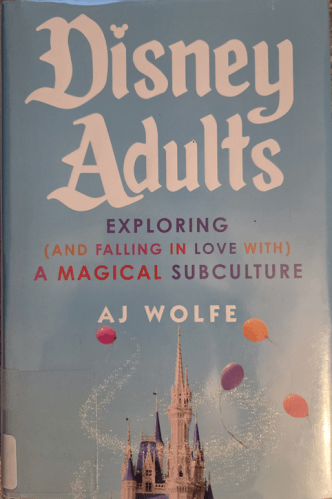
The author offers a clear and concise definition of a Disney Adult. It goes beyond an adult simply enjoying Disney movies or merchandise. As she explains, “Disney Adults are intentional about interfacing with Disney products and experiences… Disney isn’t a passing thing; it’s a cornerstone of their lives” (p. 12).
As a self-identified Disney Adult, the author draws on interviews and personal experience to situate this identity within a broader cultural context. One example she shares is a healthcare worker who deliberately sought employment at Disney and ultimately became an EMT for the company. For many Disney Adults, this level of commitment underscores that Disney is not just a brand or a form of consumption—it is a lifestyle.
The Rise of the Disney Adult
Being a Disney Adult often means adopting a perspective rooted in nostalgia. But what, exactly, is driving that nostalgia? It’s easy to assume it’s simply about Disneyland as a destination, yet that explanation falls short. Travel today is easier and more accessible than it was for previous generations.
Instead, the nostalgia at play is more specific—and more elusive. It’s less about place and more about time: particular eras, feelings, or experiences people long to relive but ultimately cannot return to.
Why Disney Adults are Mocked
Beyond defining who Disney Adults are, the author explores why this group so often becomes a target of derision. At its core, the criticism seems to challenge our modern definition of adulthood itself. As the author notes, children’s and adult entertainment were deliberately separated in the 20th century, and Disney Adults disrupt that boundary by refusing to outgrow joy that’s been culturally coded as childish.
The book also touches on how commercialization and intense fandom can shift from purchasing mementos tied to personal memory or identity into a kind of one-upmanship—where consumption becomes a way to perform uniqueness rather than preserve meaning.
Most importantly, the author acknowledges that many Disney Adults come from historically marginalized communities. In these cases, the derision is often less about Disney and more about whose identities have traditionally been deemed acceptable to express openly. What’s being policed isn’t fandom—it’s visibility.
How Does This Audience Change Disney?
What I found most striking is how clearly the relationship between Disney and its fans operates in both directions. This is not a one-way influence. Disney is actively observing, responding to, and catering to this audience—particularly adults. The most obvious signal is experiential: Disney now openly designs spaces and offerings with adult consumption in mind, including alcohol.
One small but revealing example is the now-infamous purple wall. Disney painted a wall a specific shade of purple, and fans began lining up to photograph it. Disney leaned into the attention by adding visual interest, and the behavior intensified. Soon, merchandise and themed food followed, and what began as a background detail evolved into a full-fledged moment—driven by scarcity, social sharing, and FOMO.
Areas the Author Missed
In examining the growing appeal of Disney among adults, the author misses an opportunity to engage more deeply with shifting demographics—particularly the reality that many women and couples are having fewer children. This raises a larger question about Disney’s future audience. Are Disney Adults simply a niche subculture, or do they signal a broader, more secular shift in how the company is targeting consumers?
The author also attempts to connect the Disney Adult phenomenon to recent political stances taken by Disney. While these topics are important, the connection feels underdeveloped. She does not clearly link the visibility of marginalized identities within Disney Adult communities to specific political positions the company has adopted, leaving the discussion feeling somewhat disconnected from the book’s core argument.
Finally, the author touches on inflation, rising ticket prices, and the increasing exclusivity of Disney experiences. These are compelling issues on their own, but they are not meaningfully tied back to Disney Adults or how this group may be uniquely impacted. As a result, these sections read as interesting detours rather than fully integrated parts of the analysis.
Closing Thoughts
At its strongest, Disney Adults offers a thoughtful examination of a cultural identity that is often dismissed or misunderstood. Where the book falters is not in its observations, but in its focus. The middle sections, in particular, feel weighed down by broader discussions of political scrutiny and corporate strategy—topics the author handles competently, yet ones that sit awkwardly within such a narrowly defined cultural study.
A more compelling conclusion might have emerged by fully connecting Disney Adults to larger structural shifts, including changing family dynamics and evolving entertainment consumption. Without that connective thread, discussions of politics, pricing, and business pressures feel adjacent rather than essential. Still, the book succeeds in opening a meaningful conversation about adulthood, nostalgia, and belonging—and in doing so, it makes clear that Disney Adults are less a curiosity and more a signal of how cultural identity is evolving in the modern era.
 Celebrity Book Reviews