
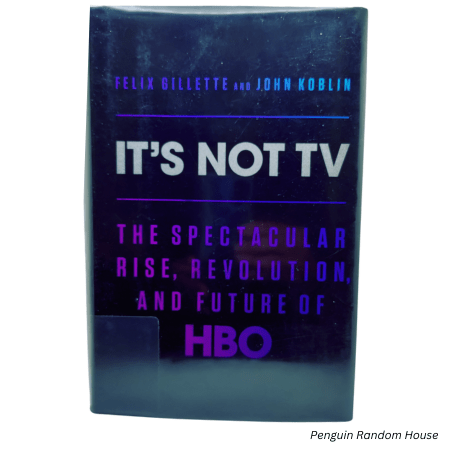
‘It’s Not TV’ gives a decades-spanning overview of the HBO cable/streaming network. What started as the destination for the Thrilla in Manilla, HBO would go on to cement itself as the place for groundbreaking, and prestige television. Though the present-day challenges are also discussed as the network faces the difficult reality of transitioning from a legacy property to a digital content provider.
Biggest Revelation:
HBO almost bought Netflix in 2006. This obviously did not happen. But, the reader is left to wonder about what the current state of digital media would be if it had.
Is it worth your time?
It is prescient that HBO started out with a boxing match in 1975 as HBO had to fight for space against the reigning incumbent of broadcast TV. According to the book, in 1976 nine out of 10 viewers watched evening programs on the big three networks: ABC, NBC, and CBS. Of course, HBO would ultimately prevail and become the go-to source for thought-provoking and original content.
The book unfolds in two distinct halves: the creative and the business. The creative aspect highlights how the network revolutionized television by empowering TV auteurs to express their unique visions. The book also emphasizes HBO’s commitment to addressing controversial and politically charged subjects, tackling issues like AIDS, criminal justice reform, and gun control.
In the later sections of the book, it becomes evident that HBO became overly reliant on a successful formula, leading to a lack of creative vision. Changes in leadership and ownership caused HBO to overlook evolving trends in popular television, as seen with their attempt at a VICE newscast that failed to resonate with millennials and the general audience’s changing viewing habits. While HBO prioritized business, it made strategic decisions that, ultimately paved the way for Netflix’s eventual dominance.
“ HBO’s long-running pursuit of profits over brand awareness would come back to haunt it, leaving the door open to streaming services.”
HBO still exists as a brand, operating through the streaming service Max, which also includes mass-market content from their corporate siblings at the Discovery Channel. This expansion is an attempt to broaden its reach and sustain its presence as an entity, reflecting a trend followed by other networks. However, taking a prestige brand to the masses can lead to a potential downward spiral.
For television enthusiasts, witnessing HBO’s strategic missteps and loss of its position as the exclusive home of prestige television can be frustrating. Yet, the rise and near-fall narrative forms an integral part of HBO’s overall story. It captivates those interested in the network’s journey, becoming just as engaging as the actual programming HBO delivers.
Authors: Felix Gillette and John Kobin
Photo Credit: Penguin Random House
 Celebrity Book Reviews